
One trusted representation of your business.

Your systems contain the data. We turn it into a consistent business model by standardizing entities, events, metrics, and logic. The result is a single, trusted foundation for reporting, analytics, and AI that everyone can rely on.

Schedule a discovery call

Your business shouldn't have multiple versions of the truth.

Your ERP tracks orders, your CRM manages customers, finance calculates margins, and operations monitors inventory. While each system is correct in its own silo, none represents the business as a whole.
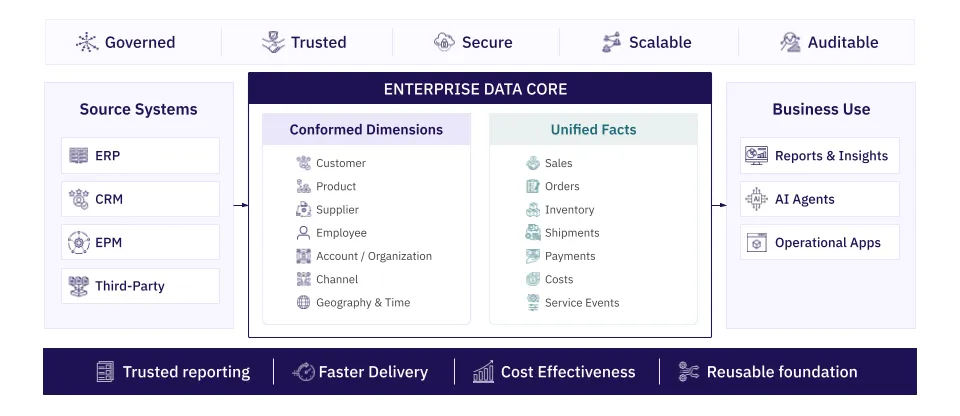
Consequently, teams spend more time reconciling conflicting numbers than making decisions. The breakdown isn't in your reporting tools; it's the absence of a shared, centralized business model beneath them.

Decisions depend on shared business context

Before you can trust a KPI, forecast demand, or deploy AI, your organization must agree on fundamental questions:

When these answers differ by department, downstream insights become impossible to trust. The Enterprise Data Core establishes these definitions once and embeds them directly into your data model, ensuring absolute consistency across reporting, analytics, and AI.

  • What exactly defines a customer?
  • When is revenue officially recognized?
  • How is the margin calculated across different channels?

When these answers differ by department, downstream insights become impossible to trust. The Enterprise Data Core establishes these definitions once and embeds them directly into your data model, ensuring absolute consistency across reporting, analytics, and AI.

We model the business not just the data

We design your data core around dimensional modeling principles because they mirror how your business actually operates. Instead of organizing data by application, we organize it by:

  1. 1

    Business Events

    The measurable activities that drive your company (sales, orders, shipments, inventory movements). These become the facts.

  2. 2

    Business Entities

    The context around those activities (customers, products, suppliers, locations). These become the dimensions.

  3. 3

    Business Rules

    The calculations, definitions, and relationships that measure performance. We embed this logic directly into the data model rather than duplicating it across dozens of isolated dashboards.

What 'good' looks like

Businesses don't make decisions based on raw database tables; they make them based on events and entities.

By organizing data around core business concepts instead of individual application schemas, we build an Enterprise Data Core that remains intuitive, easily traceable, and reusable across all downstream reporting and AI applications.

Enterprise Data Core Services

Business Discovery & Process Modeling

We start with the decisions your business needs to make and map the processes, entities, and events that drive them.

Enterprise Dimensional Modeling

Designing intuitive, highly performant fact and dimension models based on proven Kimball principles.

Centralized Metrics & Logic

Standardizing KPI definitions and embedding business rules directly into the data layer.

Conformed Enterprise Models

Connecting finance, operations, sales, and supply chain into one unified, cross-functional view.

Analytics & Semantic Foundations

Building clean, reporting-ready models to power executive dashboards, self-service BI, and AI.

Lineage & Traceability

Ensuring every metric can be traced directly back to its source system, giving your teams ultimate confidence in the numbers.

Signs your business has outgrown its current data model:

  • Different departments report conflicting numbers for the same KPIs.
  • Business logic is hidden inside individual spreadsheets or dashboard files.
  • Data models are organized around database schemas rather than real-world business processes.
  • Combining data from ERP, CRM, and operational systems requires manual, repetitive reconciliation.
  • AI initiatives produce unreliable or conflicting outputs because they lack standardized business definitions.

What changes for your business:

  1. 1

    One shared language

    Core entities like "customer" or "product" mean the exact same thing to every team.

  2. 2

    Metrics everyone trusts

    Key metrics are defined once, governed centrally, and reused everywhere.

  3. 3

    Decisions, not reconciliations

    Teams spend zero time arguing over whose data is correct and more time acting on insights.

  4. 4

    AI with business context

    Your AI models operate on the same governed business logic as your analysts, minimizing hallucinations and conflicting outputs.

  5. 5

    A future-proof model

    When operational systems change, your central business model preserves continuity without breaking downstream reports.